
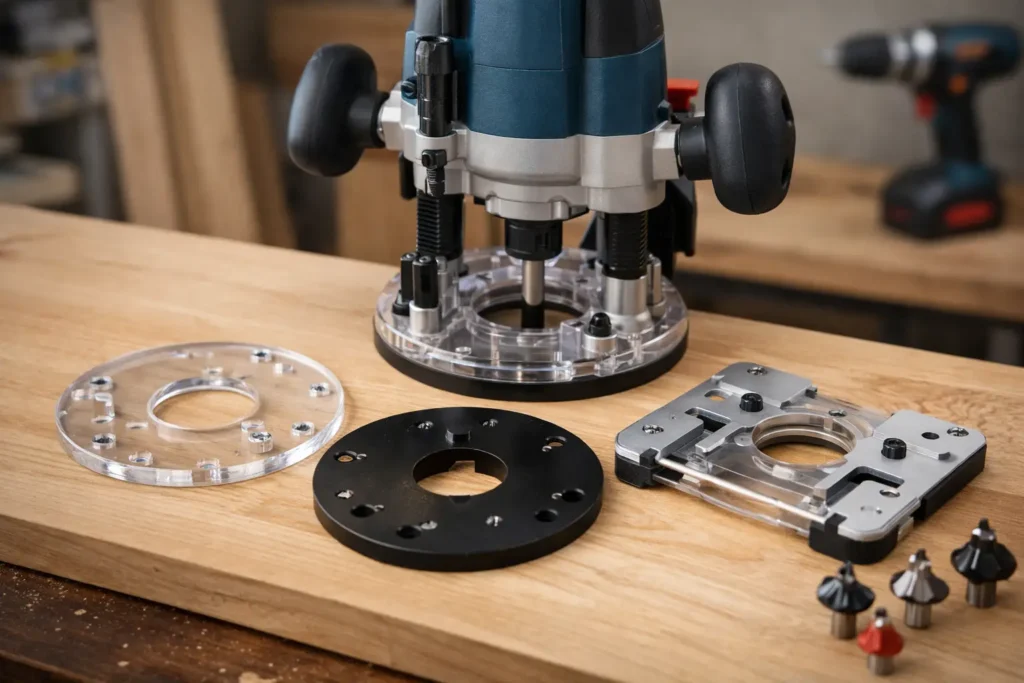
A baseplate can look like a simple flat piece of plastic or aluminum until it does not fit your router. Then a small mismatch in screw spacing, counterbore depth, or motor-housing clearance can stop the installation before it starts. So, are router baseplates universal? Usually not. A router baseplate must match the mounting pattern and physical shape of the specific router it is intended to fit.
That does not mean replacement and upgrade options are difficult to find. It means the router brand and model matter before you order. The fastest path is to identify your router, confirm the mounting details, and choose a baseplate made for that platform.
Are Router Baseplates Universal Across Brands?
No. There is no single mounting standard shared by every handheld router. Manufacturers use different screw patterns, screw sizes, mounting-hole locations, and plate shapes. Even routers from the same manufacturer may use different patterns between compact routers, fixed-base routers, plunge routers, and older models.
A baseplate designed for one router may appear close enough to fit another, but close is not good enough. The holes need to line up without forcing the screws. The plate must sit flat against the router base, clear any raised features, and keep the bit opening centered on the collet. If any of those details are wrong, the router can be harder to control and less accurate in use.
Some aftermarket plates are described as universal because they are supplied as blank material or include several predrilled mounting patterns. That is different from saying they fit every router. A multi-pattern plate may cover several common models, but it still needs to be checked against your specific router before installation.
Why Router Baseplate Compatibility Matters
The factory baseplate on many routers is small, thin, or shaped for general use. A larger replacement baseplate gives you more support along an edge guide, template, jig, or workpiece. It can also provide a better platform for guide bushings, circle-cutting fixtures, and precision routing tasks.
Those benefits depend on proper fit. A plate that rocks, flexes, or sits off-center creates problems that are easy to miss until a project is underway. When routing template parts, hinge mortises, inlay recesses, cabinet components, or sign lettering, a small error at the base can show up clearly in the cut.
Centering matters especially when you use guide bushings. The guide bushing is centered on the baseplate opening, while the bit is centered on the router collet. If the baseplate opening is not accurately centered on the bit, the bushing will not follow a template at the expected offset. Your finished work can end up oversized, undersized, or uneven.
What Determines Whether a Baseplate Fits?
Router compatibility is more than the number of mounting screws. Check the full mounting arrangement before buying.
Mounting-hole pattern and screw size
The screw holes must match the router base exactly. Their spacing, position, and thread size all matter. A plate may have the same number of holes as your router and still be incompatible because the holes are located differently or the supplied screws do not match the router’s threads.
Use the original baseplate as a reference. Remove it only after unplugging the router, then compare its mounting holes with the product specifications or plate diagram. Do not enlarge mounting holes or force screws into a router housing just to make a plate fit. That can damage the threads and leave the plate misaligned.
Base shape and clearance
Many router bases have molded contours, raised screw bosses, dust-collection features, depth-stop parts, or handles that affect how a plate sits. A compatible baseplate has clearance in the right places. A generic flat plate may contact a raised area and never sit fully flush, even if the screw pattern appears correct.
Plate size also matters. An oversized plate can be useful for stability, but it must not interfere with handles, plunge posts, switch access, depth adjustments, or edge-guide attachment points. Check how you use the router, not just whether the plate can be bolted on.
Bit opening and accessory requirements
The center opening needs to suit your work. A larger opening provides clearance for bigger bits and some guide-bushing setups. A smaller opening gives more material around the bit for support when working close to an edge or on narrow stock.
If you use template guides, confirm that the baseplate accepts the guide-bushing style you own or plan to use. Some plates have a dedicated recess for a common guide-bushing system. Others require an insert ring or a different accessory arrangement. A plate can fit the router properly but still be the wrong choice for your routing setup.
Plate thickness and screw length
Replacement plates are often thicker than the factory plate. That is useful for stiffness, but it changes the screw-length requirement. Screws that are too short may not engage enough thread. Screws that are too long can bottom out or contact internal parts before the plate is secure.
Use the screws specified for the plate and router combination whenever they are supplied. Once installed, the screw heads should sit flush or below the working face. A raised screw head can scratch a workpiece, catch on a template, or throw off smooth routing.
How to Identify the Right Router Baseplate
Start with the information on the router’s nameplate. Record the manufacturer, model number, and router type. “Compact router” or “plunge router” is not specific enough because similar-looking models can have different mounting patterns.
Next, check whether your router is being used with its fixed base, plunge base, or another accessory base. In many cases, the plate mounts to the base assembly rather than directly to the motor. A baseplate that fits the fixed base may not fit the plunge base from the same router kit.
Then consider the job the plate needs to do. For general edge work, a clear, larger plate may be the practical choice because it improves visibility and support. For template routing, prioritize accurate guide-bushing compatibility and a centered opening. For a dedicated jig, you may need specific mounting holes, a particular plate size, or a custom shape.
Before tightening anything, place the baseplate against the router and confirm that it sits flat. Install screws by hand first, alternating between them as you snug them down. Do not overtighten screws into plastic housings or strip the threads. Finally, check that the bit is centered in the opening and that the router rests stable on a flat surface.
When a Custom Baseplate Makes Sense
A standard router-specific plate is usually the most efficient option. Custom work becomes worthwhile when the router is older, modified, uncommon, or being used in a specialized fixture. It can also make sense when you need an unusual outside shape, a nonstandard guide-bushing opening, extra mounting holes, or a plate designed around a jig.
A custom plate should begin with accurate information, not an estimate. Provide the router brand and model, the base being used, mounting-hole measurements, any required opening or insert details, and the purpose of the plate. A tracing or clear photo of the factory baseplate can help clarify contours and hole locations when discussing a nonstandard setup.
For a router that does not match a regular catalog option, Hobby Woodcraft can help with custom-order requirements. The goal is not to make a nearly compatible plate work. It is to build or select a plate that mounts correctly and supports the way you actually route.
Common Fitment Mistakes to Avoid
The most common mistake is ordering by brand alone. Brand narrows the choices, but model confirmation prevents most wrong-fit orders. Another is assuming a plate will fit because a forum post or product photo shows a similar router. Manufacturers revise models, and visual similarity does not confirm screw spacing.
Avoid using a baseplate with a damaged or enlarged center opening for precision template work. Also inspect the plate periodically for cracks around screw holes, deep scratches on the bottom face, and loosened hardware. A baseplate is a wear item in the sense that it takes contact with jigs, templates, and workpieces, but it should remain flat and secure.
The right baseplate is the one that matches your exact router base, accepts the accessories your work requires, and stays flat under normal shop use. Check the model before ordering, and you will spend your time routing parts instead of modifying hardware to fit.