
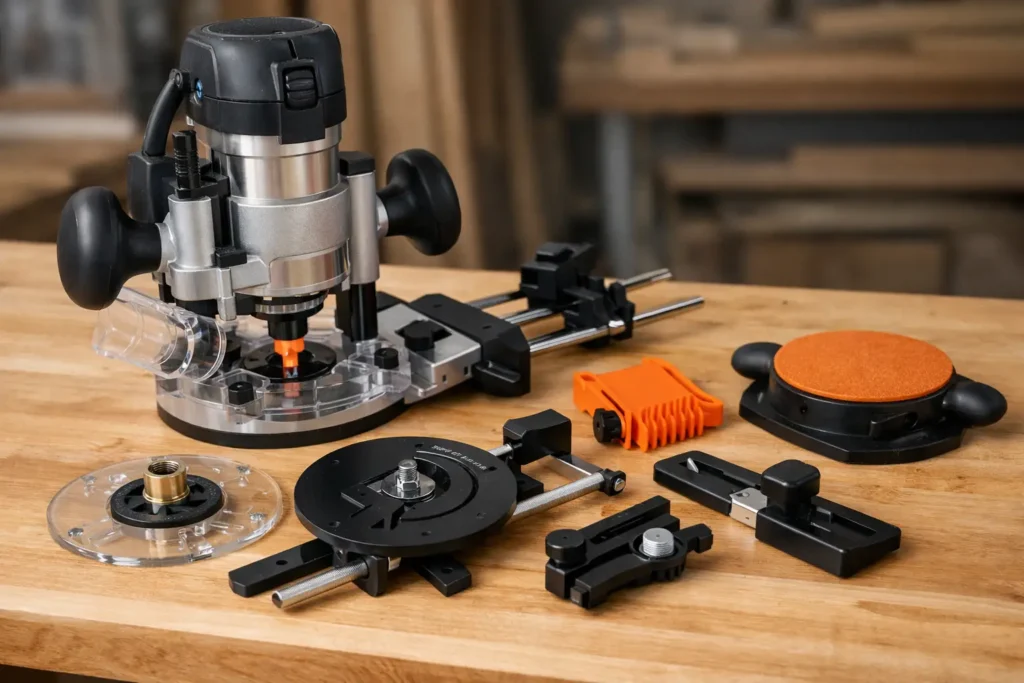
A router can make a clean profile, follow a template, or cut a precise recess – but only when the tool is properly supported and guided. The right woodworking router accessories improve control at the point where it matters: the base, the guide, and the workpiece. Start with fitment, then choose accessories that solve the operation in front of you.
Start With Router Brand and Baseplate Fitment
A baseplate is not a universal purchase. Router housings use different mounting-hole patterns, centering arrangements, and diameters. A plate that looks close may still mount off-center, interfere with controls, or leave too little clearance around the bit.
Identify the router brand and exact model before ordering. Check the mounting pattern, screw size, plate diameter, and whether the router has an unusual factory base. This takes a few minutes and prevents the most common accessory problem: buying a useful part that does not fit the tool.
A purpose-built replacement baseplate can make a handheld router easier to control than the small plate included with many routers. A larger plate spreads the router’s weight over more surface area. That extra support is especially useful when routing narrow stock, following a template, cutting stopped grooves, or working close to a board edge.
Clear acrylic plates are popular because they let you see layout lines and the bit position. That visibility is useful for inlays, hinge mortises, sign work, and small template openings. The trade-off is that clear material can show scratches sooner than opaque material. Keep the bottom surface clean and smooth so it slides across the work without marking finished faces.
For nonstandard setups, measure rather than guess. Record the outside diameter of the router base, the distance between mounting holes, and any features that could contact the plate. A custom-order baseplate is often the practical answer when a router has been modified, discontinued, or fitted with an uncommon accessory.
Woodworking Router Accessories for Better Guidance
Once the router has a stable base, select the accessory that controls its path. A router bit cuts where the tool goes. Better guidance produces better joinery and cleaner repeatable work.
Guide Bushings for Templates and Jigs
Guide bushings mount in the router base and ride against the edge of a template. They are useful for cutting mortises, inlays, hinge recesses, dadoes, and repeated shapes. The bushing, not the bit bearing, controls the cut line.
The key detail is offset. Because the bushing has a larger outside diameter than the bit, the template opening must account for the difference. A centered baseplate matters here. If the bushing is not concentric with the bit, every cut can shift from the intended location.
Use a test piece before cutting project parts. A simple scrap test verifies the template size, bushing fit, bit selection, and direction of travel. It is quicker to adjust a jig on scrap than to repair a misplaced mortise in a cabinet side.
Edge Guides for Straight, Parallel Cuts
An edge guide keeps the router a fixed distance from the edge of a board. It is a practical choice for grooves, rabbets, shallow dadoes, and repeated layout work where a full template would be unnecessary.
Edge guides work best when the reference edge is straight and the workpiece is supported. A bowed board edge transfers its error into the routed cut. For long pieces, clamp the stock securely and support both ends so the router does not tip as you move along the edge.
A straightedge clamped to the work can serve a similar purpose, particularly for cross-grain dados or cuts that are too far from the edge for a standard guide. In that setup, a wide baseplate is valuable because it gives the router more bearing surface against the straightedge.
Template Guides, Bearings, and Pattern Bits
Bearing-guided pattern bits and guide bushings can both follow a template, but they are not interchangeable in every job. A pattern bit is quick when the template can sit directly on the workpiece and the bearing can reach its edge. It avoids calculating bushing offset, but bit length and bearing position limit where it can be used.
Guide bushings are more flexible for interior cutouts and template-controlled recesses. They also let you use a wider selection of straight bits. Choose the method based on the workpiece thickness, template position, cut depth, and whether you need to remove material inside a closed opening.
Accessories That Improve Router Stability
Router control is not only about where the cutter travels. It is also about how the base stays planted during the pass. Instability leads to uneven depth, chatter marks, and cuts that drift at the last inch.
A larger baseplate is one of the simplest upgrades for stability. It helps when the router crosses a narrow rail, runs along a jig, or works over an opening in a template. The added size should not make the router awkward to handle, though. For small detail work, a plate that is excessively large can reduce access and make tight curves harder to follow.
A shop-made auxiliary base can be useful for a one-off task, but it needs accurate mounting and a centered opening. If you use one, countersink screws fully so no metal touches the workpiece. Check that the bit clears the opening at every depth setting and that the plate remains flat after mounting.
Other support accessories are often job-specific. A vacuum attachment can improve visibility and keep chips from packing into a narrow groove. A router table insert plate can turn the same motor into a more controlled setup for small molding work. Featherboards and push blocks add safety at the table, but they are not substitutes for proper bit height, feed direction, and a stable fence.
Match the Accessory to the Cut
Do not buy accessories only because they appear broadly useful. Match them to the cuts you make most often. A furniture builder cutting mortises and template-shaped parts will benefit from a centered baseplate, guide bushings, and template-routing capability. A cabinet installer may get more use from an edge guide, straightedge setup, and a baseplate that rides reliably on site-made jigs.
For signs, inlays, and detailed decorative work, visibility and centering take priority. A clear baseplate and correctly sized bushing help you place cuts accurately. For edge profiles and roundovers, stable work support and a bit with a properly functioning bearing may matter more than a specialized guide system.
Keep expectations realistic. No accessory corrects a dull bit, a loose collet, warped stock, or an unstable workbench. Check the router before each session: the bit should be fully seated correctly, the collet tight, the base secure, and the work clamped. Make shallow passes when removing significant material. Multiple controlled passes usually leave a cleaner result than forcing one deep cut.
A Quick Fitment Check Before You Order
Before choosing a baseplate or guide accessory, confirm these details:
- Router brand, model number, and whether it is a fixed-base or plunge router
- Existing base diameter and mounting-hole pattern
- The type of work you need to guide: edge cuts, templates, straight grooves, or interior recesses
- Required guide-bushing size, bit diameter, and clearance around the cutter
- Whether the project needs a standard plate or a custom mounting solution
If your router is an uncommon model or your project needs a special mounting arrangement, provide measurements and a clear description of the job. Hobby Woodcraft organizes baseplate choices by router brand to make standard fitment faster, with custom-order support available when the standard path does not apply.
The best router accessory is the one that mounts correctly, stays flat, and makes your next cut easier to control. Verify the router model first, test the setup on scrap, and let the project determine the accessory – not the other way around.
A very informative article!